
Compare Calhoun Property Values
A Calhoun County parcel can hold several numbers. Name each figure rather than calling every one the property's value.
| Value type | What it means | Where it is recorded |
|---|---|---|
| Assessed value | The local assessment under Michigan's value framework | Assessor or parcel card for the stated tax year |
| State Equalized Value | Assessed value after equalization, often shown as Final SEV | Assessment record |
| Taxable value | The value used as the base for millage calculations | Assessment and tax record |
| Last sale price | Evidence from a past transfer, not a present valuation guarantee | Sales display and recorded instrument |
| Land and improvements | Assessor components describing land and building value | FetchGIS parcel report |
The state assessor guide places assessed value inside a constitutional 50 percent true-cash-value framework. Taxable value is a separate field. Proposal A caps and ownership-transfer rules can move it independently. Never substitute it for SEV or a sale price.
Read Calhoun Assessment Fields
The FetchGIS report shell lists prior-year MBOR Assessed, Final SEV, Final Taxable, and earlier columns, plus acreage, land value, land improvements, building details, sales, delinquent-tax data, and tax history. MBOR reflects the March Board of Review context in the field label. Copy the labels exactly. Do not simplify them. Simplified field names invite mismatched year-to-year figures. The county's BS&A service page offers the assessment and property-sale search route that reaches those parcel-specific records.
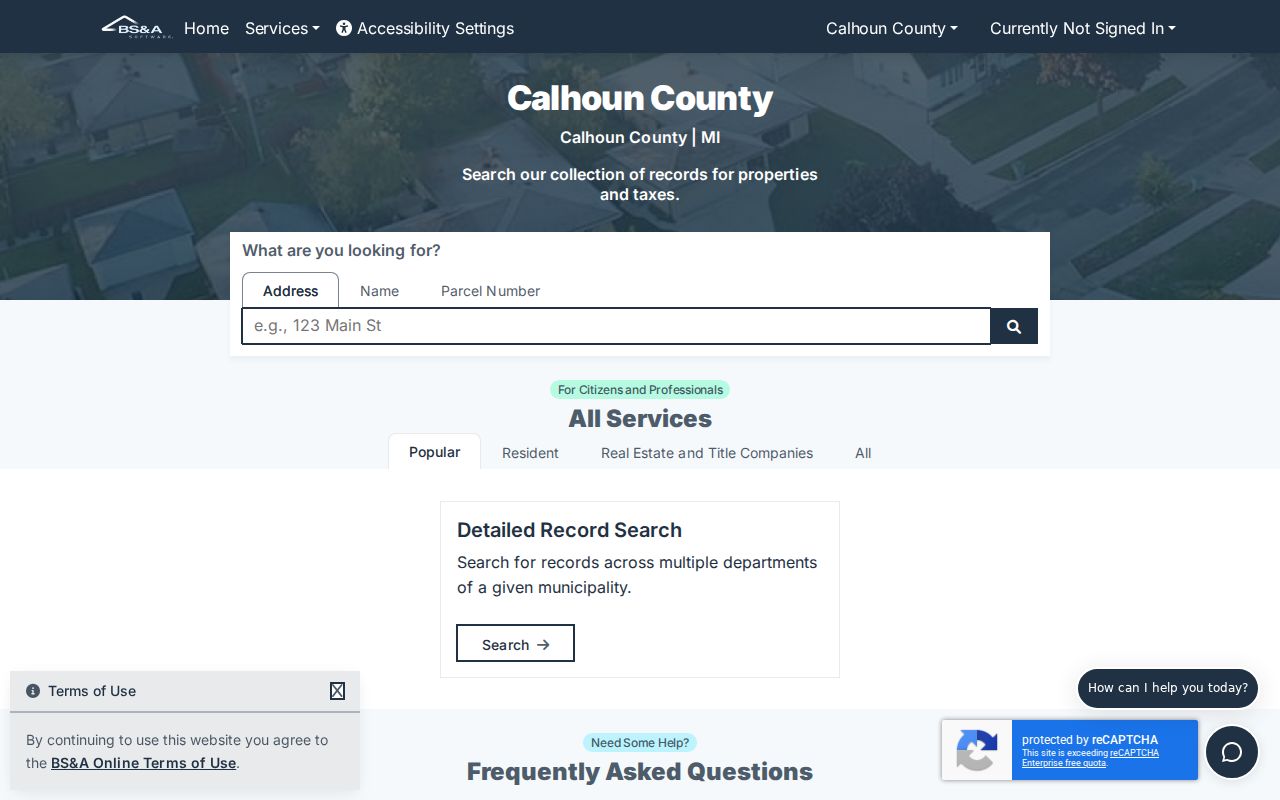
The landing page names the available search services. It is not a valuation card. Pick the correct Calhoun County parcel before copying any figure. Building fields may cover type, year built, style, exterior, living area, heating, rooms, bedrooms, baths, basement, garage, porch, and deck. Those entries are assessor descriptors, not an inspection or certified architectural measure. Do not stretch them into a market estimate.
- Assessed value
- The local assessment measure under Michigan law.
- Market value
- An opinion of likely exchange value as of a stated date and conditions.
- Assessment ratio
- The relationship between assessed and true cash value in the state framework.
- Reassessment
- A later valuation action tied to a defined tax year.
Estimate Calhoun Property Value
The lookup begins with identity, not arithmetic. Confirm the parcel before copying values.
- Search the complete address in Calhoun FetchGIS and copy the PIN, municipality, and report date.
- Record MBOR Assessed, Final SEV, and Final Taxable as separate fields for each shown year.
- Copy land, improvement, building, and sales fields only when displayed.
- Check the matching assessment record in Calhoun County BS&A.
- Use the latest deed and transfer material when a recorded transaction must be verified.
A blank cell is not zero. It may mean not applicable, not collected, or simply not rendered, so note it as blank unless the portal expressly reports none.
Distinguish Calhoun SEV and Taxable
Final SEV and Final Taxable can move differently. Michigan's Proposal A framework caps taxable-value growth under stated rules. An ownership transfer or similar event changes that treatment. Uncapping can then arrive in the next calendar year. The state assigns the buyer the Property Transfer Affidavit, Form 2766, filed within 45 days. That deadline is not a portal refresh date. Compare the transfer date, recording date, tax year, and first year the taxable value changed. A jump is a clue, but only the recorded instrument proves a transfer.
Note: Taxable value is the millage base; Final SEV is a different field and may not match it.
Compare Calhoun Sale Evidence
A parcel report's Sales Information area can point to a transfer date or amount. Treat it as a lead. The deed index and image can show parties, instrument and recorded dates, document type, legal description, and any consideration or transfer-tax notation in the record. A sale price belongs to a past deal. It carries its own date and conditions. It is not an automatic estimate of today's property value. Family, fiduciary, partial-interest, quitclaim, and entity transfers may all need more context before a displayed amount is compared with a market transaction. Search the Register's advanced form by grantee, grantor, date, document number, address, or legal field. Keep the deed's land description aligned with the PIN.
Date Calhoun Property Values
Each number needs a tax year and a source. Record the portal's as-of or certification text when it appears, along with your access date. Different systems refresh on different schedules. GIS, assessment, tax, and deed data for Calhoun County parcels follow no single published refresh cadence, and the county states no last-revaluation year. For year-to-year comparisons, use one row per tax year. Preserve assessed value, SEV, taxable value, PRE percentage if shown, and the portal date. Keep transfer and recorded dates in separate columns. That layout makes a possible uncapping event visible without turning the pattern into an unsupported claim.
Understand Calhoun Value Components
Land value, land improvements, and building details show how the assessor sees a parcel. Acreage, frontage, depth, pool, zoning, and structure fields can explain why two Calhoun County records differ. None of it is a survey. It is not an inspection or appraisal either. The tax description may be abbreviated. Boundary and interest questions need primary documents. Check the deed, plat, condominium master deed, exhibit, or survey reference, since a GIS shape only orients the value record and the viewer expressly disclaims survey and legal-document status.
Keep Calhoun Exemptions Separate
Principal Residence Exemption percentage, poverty exemption, and the state Homestead Property Tax Credit can change a tax bill or offer relief. They do not set market value. Michigan's 2026 credit reminder is a state guidance update, not a Calhoun County levy change. For the tax bill, exemption rules, and appeal routes, use the Calhoun County property tax records resource. Let the value comparison stop there. Match each valuation field to its meaning and location.
Limit a Calhoun Value Estimate
An assessed value drives the tax roll for one year. It is not a sales forecast. Final SEV should never be treated as a listing price. Taxable value is not a market appraisal either. The latest consideration recorded on a deed is simply what changed hands at that moment. It is not a current valuation of the parcel.
Value is not price: A Calhoun County assessed value is for taxation and is not what the property will sell for. It is not an appraisal.
A qualified appraiser is the right professional when a transaction or legal matter needs a market opinion. The assessor keeps the official assessment record. The Treasurer handles account status. The Register of Deeds holds recorded transfer evidence. Keeping those roles apart stops a tax field from being mistaken for a sale forecast.
Before comparing two Calhoun County properties, confirm both records rely on the same value field and the same year. Match like with like. A Final SEV from one parcel should never sit beside taxable value from another. Land and improvement splits also deserve their original labels. Differences in acreage, unit type, building data, municipality, or assessment year can explain why similar-looking figures are not true equivalents. Check the source fields first.
Payment and delinquency records answer a separate question. The county Treasurer portal searches real-estate tax accounts by year and status, while BS&A and FetchGIS offer delinquency-related functions. A paid balance never raises the source's estimate of market value. An unpaid balance does not by itself prove foreclosure or a title change. Keep account status and valuation in separate evidence columns.
Save the original card before asking for any review. Then provide the PIN, municipality, tax year, field label, displayed amount, source URL, and access date. Ask the right assessor about the existing assessment record. A narrow question about one field works better than asking the county for a new appraisal. Older Calhoun values may call for historic assessment rolls. Archives of Michigan collections and local libraries can help locate roll years, property inventories, maps, and directories. Those sources show how a parcel was described in an earlier period, but the collection year and page must stay with the number. A historic assessment should never be recast as today's property value.