
Read Calhoun County Property Tax Records
Valuation and payment live in different places in Calhoun County property tax records. FetchGIS and BS&A carry the assessment-facing fields, while QPayBill handles the dated tax account and receipts. Keep the PIN and tax year beside every value so parcels and cycles never get mixed.
| Field | What It Shows | Where |
|---|---|---|
| MBOR Assessed and Final SEV | Assessment and equalized-value labels for the stated year | FetchGIS or BS&A |
| Final Taxable | The value to which millage is applied | FetchGIS or BS&A |
| PRE and relief fields | Parcel exemption context, distinct from a state income-tax credit | Assessment record and state guidance |
| Paid, unpaid, or all | Account status for a selected tax year | County Treasurer QPayBill |
| Tax history and delinquency | Dated account leads requiring milestone verification | FetchGIS, BS&A, Treasurer |
Michigan caps assessed value at 50 percent of true cash value. So SEV, taxable value, a sale price, and a tax balance are four figures that cannot stand in for one another.
Calhoun Values Follow Michigan's 50 Percent Framework
State assessing guidance treats assessed value as the constitutional 50-percent true-cash-value framework. County equalization then produces the SEV. Taxable value is a different animal, capped by Proposal A. A transfer can uncap it for the next calendar year under state ownership-change rules.
The buyer must file Michigan Property Transfer Affidavit Form 2766 within 45 days. That deadline says nothing about how fast a Calhoun screen refreshes. Before explaining any change, line up the transfer date, the recording date, the tax year, and the display date side by side.
Look Up a Calhoun County Tax Bill
The Treasurer's QPayBill portal gives Real Estate among its search types. Users can filter by paid, unpaid, or all status, pick a tax year, set the Search By field, and type their entry. For name searches, the page asks for the last name first, then the first name.
- Start from the verified PIN and municipality, then choose Real Estate and the relevant tax year.
- Read the status and amount only for the displayed account and date. Save or print the online receipt when needed.
- Compare assessment, SEV, taxable value, and PRE fields in BS&A or FetchGIS for the same year.
- If delinquency language appears, identify the specific milestone before describing the parcel as forfeited or foreclosed.
- Assessed value
- The assessor's value under Michigan's assessment framework.
- Taxable value
- The value used with millage to calculate property tax.
- Millage
- The set of local rates applied to taxable value for the taxing units shown.
- PRE
- Principal Residence Exemption treatment, which must not be confused with a state tax credit.
The portal caps credit-card transactions at $99,999 and mails no paper receipt. Its online receipt proves the payment shown, nothing more; it is not a title-clearance certificate.
Calhoun's Treasurer Search Separates Account Types
QPayBill separates Vehicle, Real Estate, Personal, Watercraft, and All. Pick Real Estate for land and improvements. An All search can blur account types together. Payment Status and Tax Year narrow the results further. The Search By field governs how your text gets read. The official tax-search page displays these controls along with the payment warning.
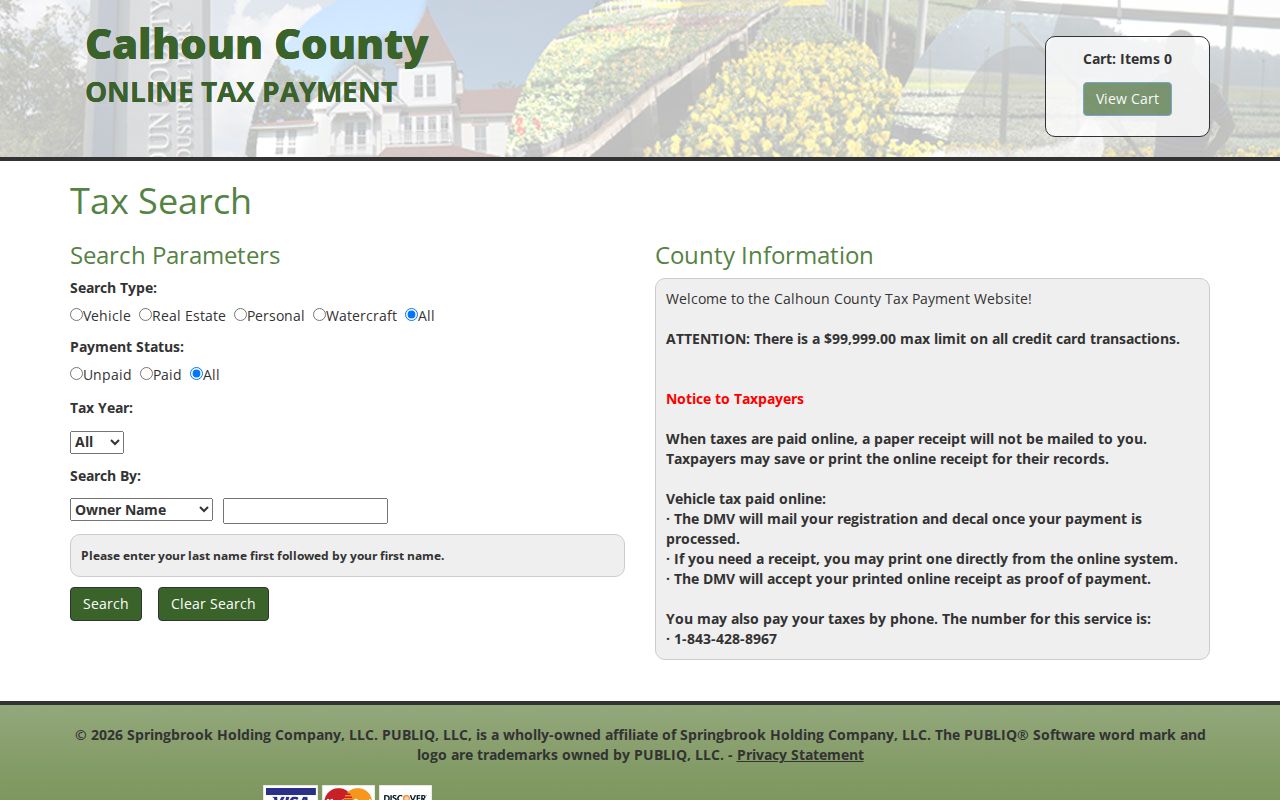
The Treasurer's official lookup page appears empty of any private parcel account, showing only its public search controls.
Delinquent Calhoun Taxes Are Not a Foreclosure Finding
Delinquency is not foreclosure. FetchGIS can surface delinquent-tax and tax-history clues. BS&A offers a delinquent search. QPayBill shows paid or unpaid status. None of the three proves a completed foreclosure. Michigan's official three-year chronology separates delinquency, forfeiture, notice, petition, judgment, redemption, auction, and disposition.
Gather the specifics: PIN, affected years, certificate of forfeiture, notice dates, petition and judgment references, redemption deadline, auction result, later disposition, and any recorded deed. The state chronology frames the process. The parcel's own county, court, or Register record establishes which step actually occurred.
Keep Calhoun PRE, Exemptions, and Credits Apart
Michigan's Principal Residence Exemption shapes the parcel's property-tax record directly. Poverty exemption runs on its own local application and review route. The Homestead Property Tax Credit is a state income-tax credit, so it never replaces the taxable-value or PRE fields on an account.
A 2026 Michigan Treasury reminder urged taxpayers to check credit eligibility. That was general guidance, not a Calhoun levy change. Use the state page for the tax year at issue. For the parcel's exemption form, evidence, and Board of Review schedule, ask the local assessor.
Track a Calhoun Transfer Through Proposal A
A transfer can move taxable value even when the parcel itself has not changed. Under Michigan ownership-change rules, taxable value may uncap for the calendar year after a transfer. So compare the deed's instrument and recording dates. Check the prior tax-year card as well. Then look at the next year's taxable value and the Property Transfer Affidavit before explaining a jump. The state requires the buyer to file Form 2766 within 45 days.
That filing deadline sets no refresh schedule for a Calhoun assessment screen. The tax display and the newest deed sometimes show different owners. Keep both observations with their dates. Ask the assessor or Register which record governs your purpose.
Transfer tax is a separate question again. Form 2705 may apply when consideration is omitted. It may also apply to certain controlling-interest transfers. Never infer price or exemption from an index row alone. Inspect the deed, the affidavit, the transfer-tax notation, and any exemption code as distinct records.
A Calhoun Tax Receipt Does Not Clear Title
A paid stamp answers one narrow question. It shows that a specific real-estate account shows payment in the Treasurer's system. That payment applies to one specific year. It proves nothing about other tax years, other liens, or who actually holds title. Save the receipt, tax year, PIN, and payment date together. Add the portal date and amount, and keep it all as one dated record.
QPayBill says no paper receipt follows an online payment. The portal also caps a credit-card transaction at $99,999. Any notice demanding a paper-receipt fee should go straight to the Treasurer. Do not send it to whoever sent the demand.
For title questions, search the Register for recorded liens, releases, forfeiture certificates, and judgments. Add auction deeds and later conveyances to that search. Read account status and recorded land documents side by side. Neither one substitutes for the other.
Build a Calhoun Property Tax Discrepancy Table
When sources disagree, build three dated rows. Row one holds the newest deed: document number, parties, recording date, legal description, and image status. Row two holds the assessment display: owner field, PIN, tax year, assessed value, SEV, taxable value, and report date. Row three holds the Treasurer query: year, paid or unpaid status, balance or receipt, and access date.
Report the conflict without picking a winner. A recent recorded transfer could explain it. A later tax-year update could too. A municipality mismatch or a simple search-input error could explain it as well. The Register handles recording questions, the assessor handles the roll, and the Treasurer handles the account.
One common property tax records mistake deserves a mention. A blank portal shell is not a zero balance. Only a selected parcel and year can support an account statement.
Municipal geography belongs in the table too. A Battle Creek, Albion, or Marshall mailing address can sit in a different taxing city or township. Check the municipal-boundary layer, the tax description, and the local assessor. Do this before applying any exemption schedule, Board of Review date, or millage from a familiar city name.
For historical comparison, label every figure. Is it assessed value, SEV, taxable value, land value, improvement value, or total tax? Comparing unlike labels invites error, and no figure should be adjusted without its source preserved. FetchGIS can display prior-year MBOR Assessed, Final SEV, and Final Taxable fields, including last-year and earlier comparisons. This holds provided the selected report and displayed year are captured.
Calhoun County publishes no current revaluation year and no complete countywide millage schedule. Rely on the parcel-specific bill and the municipality's current assessment notice. Skip the uniform rate or cycle.
Contest a Calhoun County Assessment Locally
A value challenge belongs with the assessor and the local Board of Review, never with the Treasurer payment portal. Assemble the notice, PIN, property facts, comparable evidence, photos, and value labels for the same assessment year. Confirm the municipality first. Schedules and forms are administered locally.
Confirm the appeal window. The research did not establish one countywide filing date. Ask the parcel's local assessor for the current Board of Review session, form, and deadline.
Preserve proof of filing and the written decision. Assessed, taxable, and sale figures differ for real reasons. For a fuller explanation, see the Calhoun County property value guide. This tax page stays centered on bills, account status, exemptions, and review.
Good evidence ties to the parcel and the valuation date, not a later asking price. Keep the notice's instructions and the local form. Also keep proof of timely delivery and the exhibits. Save the hearing record and the written decision too. If the dispute concerns a clerical field, exemption, transfer treatment, or classification rather than value, say so precisely.
Afterward, compare the updated assessment field and tax year against the written result. Keep any later Treasurer adjustment or refund separate. A Board of Review decision and a posted account transaction are not the same event.