
What Calhoun County Deed Records Document
Every conveyance in Calhoun County gets indexed by the Register of Deeds. Start with the latest likely vesting document. From there, inspect the parties, capacity, legal description, recording stamp, and prior references. Work back through the deed records as you go. Remember that a deed's label is only a starting point. The actual terms and exhibits control what the instrument says.
| Deed Type | What It Does | Common Use |
|---|---|---|
| Warranty deed | Conveys an interest under warranties stated in the document | Conventional transfer |
| Quitclaim deed | Conveys the grantor's stated interest without a full title review | Corrective or interest transfer |
| Fiduciary deed | Shows a trustee or personal representative acting in a stated capacity | Trust or estate transfer |
| Master deed or plat | Creates recorded unit, lot, subdivision, or common-element context | Condominium and platted land |
The portal indexes more than deeds. Mortgages, releases, assignments, liens, plats, and land-corner material all appear there. A mortgage or lien can burden an interest without conveying it, so identify each document's role before drawing a chain-of-title conclusion.
Use Calhoun's Advanced Deed Fields
The Register advanced search opens deep filters. Party Names, Grantor, Grantee, recorded and instrument date ranges, document number, liber, page, Property Address, Document Image phrase, and Subdivision, Section, and Condo Legal fields are all available. The broad department selector also includes Property Records and Land Corners.
| Field group | Best use | Verification |
|---|---|---|
| Grantor, Grantee, Party | Follow conveyance direction and capacities | Search both roles and read the image |
| Recorded and Instrument Dates | Catch filing and signing dates | Widen both ranges when a result is missing |
| Document No., Liber, Page | Retrieve a known reference | Match the image's recording stamp |
| Address and Legal fields | Find land when a name fails | Match the complete legal description |
The full local list of document types runs long. Open the live menu and record the exact label rather than guessing which type the Register of Deeds uses.
Follow Calhoun's Grantor-Grantee Chain
The grantor conveys the interest. The grantee receives it. Capacity matters, because trustees, personal representatives, utilities, associations, lenders, and entities can appear in roles that a simple seller-buyer label misses.
- Use the current parcel display as a lead, then search that name as Grantee to locate a likely acquisition deed.
- Open the image and save the full parties, capacity, both dates, document number, liber/page, legal description, and prior reference.
- Search that grantor as an earlier grantee. Run Party Names and both roles where an entity or fiduciary wording changes the direction.
- Repeat backward while matching the land each time. Mark an image gap or index-only link as provisional.
- Grantor
- The party conveying the interest described in an instrument.
- Grantee
- The party receiving that stated interest.
- Chain of title
- The connected sequence of recorded instruments for the same land.
- Liber and page
- A book-and-page recording reference used with or instead of a document number.
Read Calhoun Deed Images and Exhibits
A result row is never the whole deed. Save the first page and every continuation page. Keep the legal-description exhibit, recording stamp, signatures, notarization, preparer and return-to lines, transfer-tax notation or exemption, and prior references. For a mortgage, follow the assignments and the discharge. Plats and condominium declarations need their sheets, unit schedules, common elements, and amendments. The Register's advanced form displays the role, date, reference, address, legal, and OCR filters that surface a candidate document.
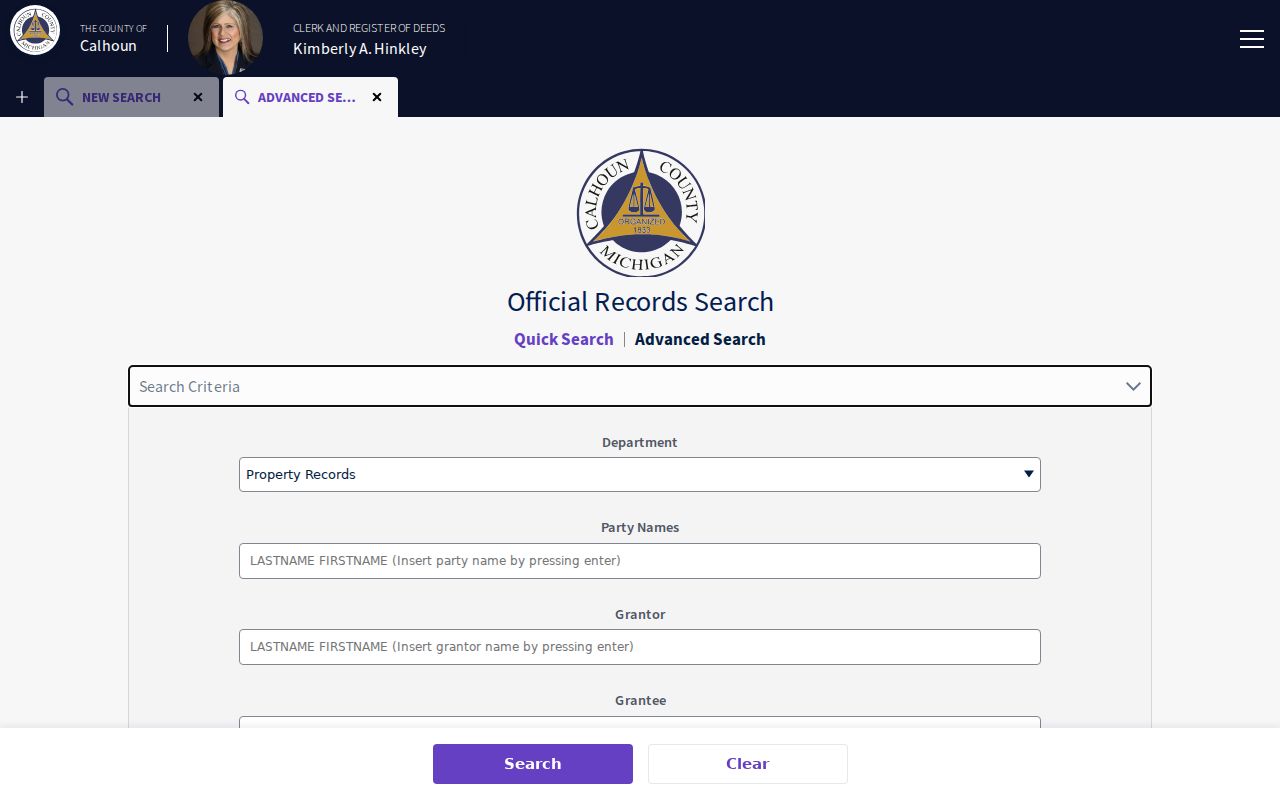
Filters narrow, but the image's legal description decides the match.
Locate Calhoun Plats, Easements, and Restrictions
An address can hide a recorded right. Check both party roles too. When the standard fields fail, run Subdivision Legal, Section Legal, and Condo Legal searches separately, since a municipality, utility, association, railroad, or developer may be indexed on just one side and easements can be granted, reserved, released, assigned, or simply mentioned within another deed. Record the benefited and burdened land, width, purpose, maintenance and termination terms, survey or exhibit, and recording reference. A GIS map can orient the search. It cannot establish the easement. Restrictions may also live in an original plat, declaration, deed, amendment, or association instrument.
Calhoun's Land Trail Predates the Online Index
The portal never states its earliest searchable year. A no-result search is not proof of no deed. Older land records survive elsewhere in Michigan. The Archives of Michigan guide lists Calhoun entry-book mortgages from 1839 to 1871 and record mortgages from 1833 to 1870 in RG 83-81. FamilySearch catalogs Early Deeds of Calhoun County for 1833 to 1843, with possible login or center restrictions. Beyond those, the Library of Michigan, Willard Library, Albion District Library, and Marshall District Library add plat, assessment, directory, newspaper, and map leads. Note whether each source is an original, microfilm, image, index, or transcription. Then return to the primary record.
Calhoun Alerts Flag New Property Filings
The free property-alert page covers Calhoun County filings. Custom keywords, multiple names, and alerts built from a found document are all supported, and an email can prompt review when a chosen personal or entity name, or phrase, appears in a future real-property filing. The service does not backfill the deed records, warrant uninterrupted delivery, or certify ownership. Treat alerts as signals. Inspect the indexed document. Contact the Register promptly if a filing is unfamiliar.
Reconcile Calhoun Deed Dates and Names
Instrument date and recorded date answer separate questions. The first tells you when a deed was signed. The second tells you when the Calhoun County recorder entered it into the public system. A transfer near a month or year boundary can hide if you search only one range, so run both. Log both dates in a deed-chain worksheet. Never let one overwrite the other.
Names need equal caution. The advanced form offers Party Names plus separate Grantor and Grantee fields, entered as LASTNAME FIRSTNAME. A surname alone proves little. Confirm the parcel with its legal description, municipality, address, dates, middle initial when shown, and recording reference. Trust, estate, personal-representative, guardian, conservator, or trustee capacity must be preserved exactly as written.
A deed and a tax owner sometimes disagree. Make a dated comparison rather than picking the name that sounds right, recording the deed number, recording date, parties, and legal description on one side and the assessment display's PIN, tax year, owner field, and report date on the other. A recent transfer with a Form 2766 filing can explain the gap. Calhoun County publishes no guaranteed closing-to-roll refresh interval.
Entity and fiduciary names deserve an extra pass. Try punctuation variants, abbreviations, former names, and the exact trustee or personal-representative phrasing. A probate reference points to MiCOURT, though its public display is informational and withholds some categories. Get the order from the proper clerk. Then match it to the recorded conveyance.
A complete worksheet earns its keep. A disciplined row lists the address, PIN, legal description, instrument date, recorded date, party role, capacity, document number, liber/page, image status, prior reference, and source date. That structure makes a break visible before a same-name party or a nearby lot slips into the chain by mistake.
Calhoun's Quick Deed Search Has Two Scopes
The Register quick search gives you a Search Term, start and end recorded dates, quick date ranges, and a choice between Search Index Only and Search Index & Full Text. Index-only mode reads each word separately. OCR mode hunts the whole phrase instead. That difference can change the result set for a subdivision name, an unusual restriction, or a phrase inside a document.
Old scans, faint type, punctuation, and handwriting all trip up OCR, so use it to spot a likely image rather than to quote a deed you have not opened. The portal's certification notice reads Certified through September 4, 2026, and the advanced page carries its own date of September 2, 2026. Neither message states historic coverage, and both can change. Note what each page displays on every visit.
The official quick-search page preserves the blank form and certification display.
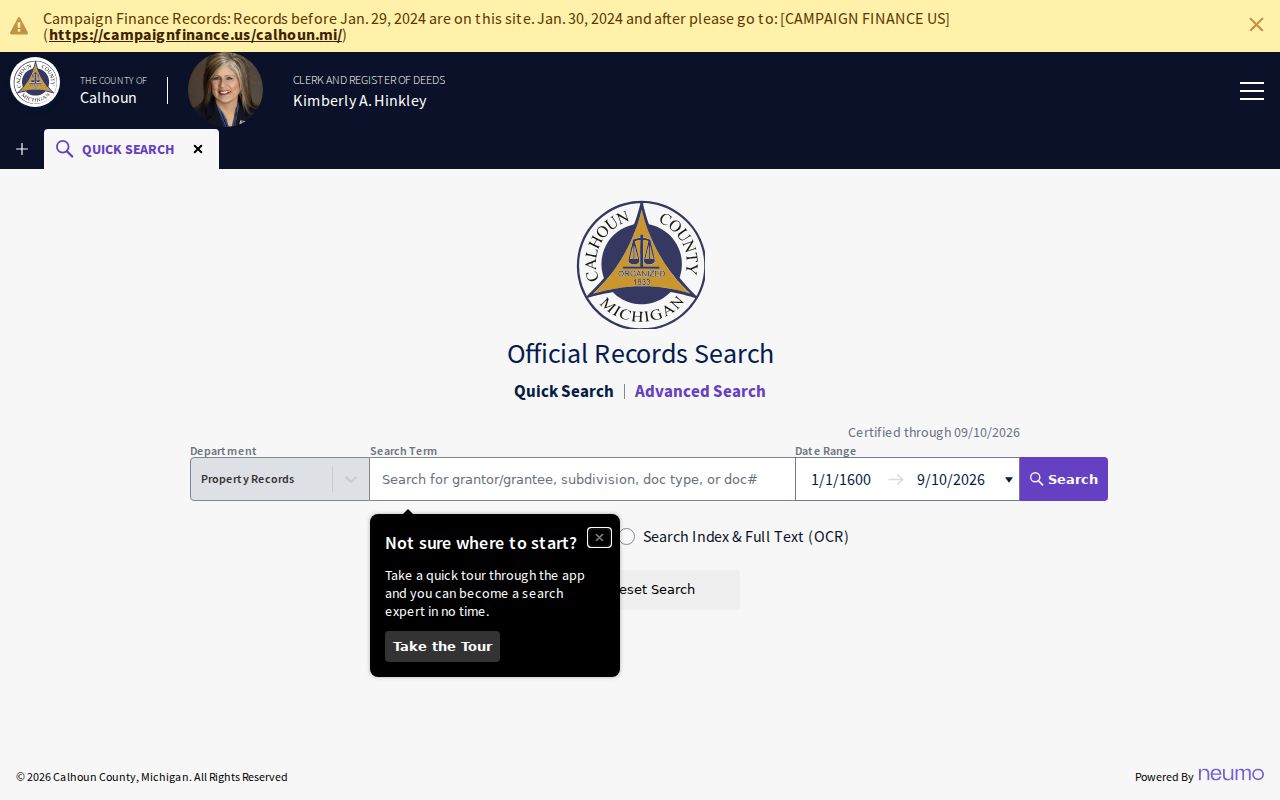
The screenshot shows search mechanics, not any selected person's deed. Keeping that line clear stops an unverified row from becoming an ownership claim.
Request a Calhoun County Deed Copy
Search online first. When you ask the Register for an image or certified copy, bring the document number, recording date, parties, and liber/page. Michigan's cited recording framework charges $10 for the first page. Each added page costs $3. A required notation adds $3 and automation adds $5, with later remonumentation changes. Those are recording fees, not a copy quote.
Recorded, not guaranteed. Recording preserves an instrument and gives it a public reference. It does not settle every boundary, make every statement true, or provide a title opinion.
The exact copy fees are unpublished. Verify the current amount and your online, counter, or mail route with the Calhoun County Register of Deeds, 315 W Green Street, Marshall, 269-781-0718. Michigan's electronic-recording standards help here. They allow a paper fallback whenever a portal image is unavailable.
At the counter or by mail, supply the exact document number, or if it is unknown, both party roles, a practical date range, the address, PIN, municipality, and a legal-description lead. Ask for all pages and exhibits. Ask the fee and electronic delivery up front. If the index entry or image cannot be produced, ask for an explanation.
Address and parcel details come first. Use the Calhoun County property search guide for that stage. A narrow request should state the address, PIN, legal description, parties, date range, and exact certification needed.