
Trace Calhoun's Former Owners
Work the ownership trail one transfer at a time. A deed-chain table keeps every step honest. It forces you to separate a true conveyance from an index hit, a mortgage party, or a name on the tax roll. Give each likely conveyance its own row and leave gaps visible. Gaps show where Calhoun County property records still need support.
| Transfer date | Grantor to grantee | Deed type | Book/page or document |
|---|---|---|---|
| Newest matching record | Prior owner to current grantee | Read the instrument | Copy the exact portal reference |
| Earlier matching record | Earlier owner to that prior owner | Read the instrument | Copy its book/page or number |
| Unresolved interval | Do not guess either party | Search estate, trust, or other transfer | Mark the missing reference |
Every instrument names its parties by role. The grantor transfers the stated interest and the grantee receives it. Those labels shift with document type. A mortgage's grantee is often a lender rather than a prior owner. Read the granting clause and legal description before trusting any party name.
Reverse Calhoun Party Roles
Start with the latest vesting deed for the Calhoun County parcel. The seller appears as grantor. Search that person or entity as grantee. This finds the earlier instrument that conveyed the land to them. A broad Party Names search may return too much. If so, split it into separate Grantor and Grantee searches and narrow the date range.
At every step compare the legal description, not just the street address. Parcel numbers can change after a split or combination. Older deed records may describe the land differently. They may use lot and block, section, condominium unit, or metes and bounds. A prior reference inside the deed often supplies the strongest next search key for the property search.
Reconstruct Calhoun Ownership Backward
The Calhoun Register advanced form carries the whole backward method. Party, role, date, document type, liber and page, address, subdivision, section, condominium, and document-image phrase fields all support a deed-chain search through Calhoun County property records.
- Locate the newest deed that matches the parcel's legal description.
- Record document number, deed type, instrument date, recorded date, grantor, grantee, and prior reference.
- Search the grantor as a grantee in an earlier date range.
- Open the earlier image and confirm that it covers the same land and interest.
- Repeat until the index stops, the land description changes, or an unresolved event appears.
- Chain of title
- The ordered sequence of instruments affecting ownership.
- Reverse index
- A way to find how a grantor previously received the interest.
- Warranty deed
- A deed whose covenants differ from a quitclaim deed.
- Quitclaim deed
- An instrument conveying the interest the grantor has, if any, without the same warranties.
Pair Calhoun Deed Dates
Instrument Date Range and Recorded Date Range are separate fields in the advanced index. A deed can be signed one month and recorded later. Search only the signing window and the index row may hide from you. Search only the recording window and the true order of Calhoun County transactions gets blurry.
Keep both dates in your ownership timeline. Also note the portal's certification date and whether the document image was available. OCR text can pull a subdivision or road phrase out of an exhibit. But scanned names and lot numbers are often misread. So verify against the image itself.
The official page for the advanced deed search fields displays the role, date, address, legal, and document-reference controls.
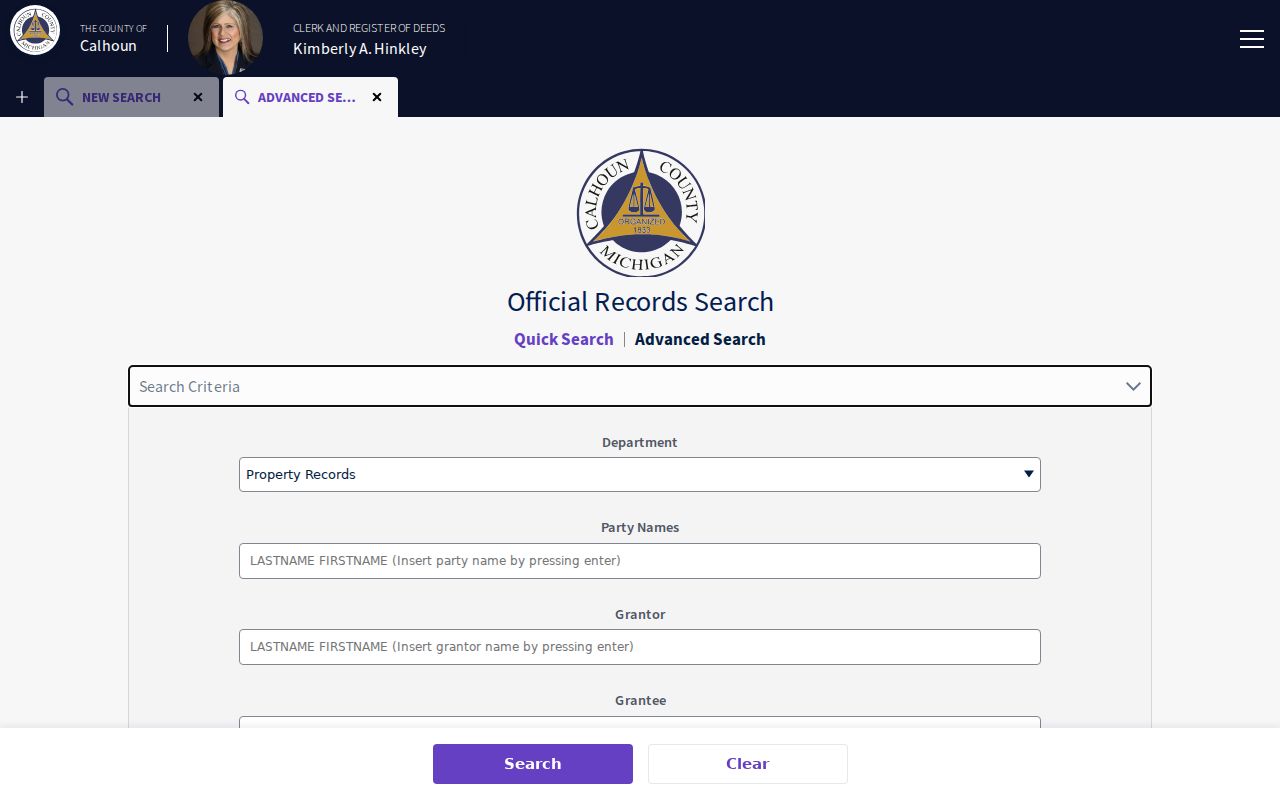
Those controls make the chain repeatable. Still, only the instrument image and its land description decide whether a hit belongs in your Calhoun County deed records chain.
Go Beyond Calhoun's Online Index
The Register does not publish the earliest year covered by the online index. Do not assume a cutoff. When your former owners fall before the years the property search returns, contact the Register of Deeds. Ask about older deed books or image access. State and local collections hold more, and concrete series terms make those requests productive.
| Older source | Useful request term | Role in the chain |
|---|---|---|
| Archives of Michigan | RG 83-81 mortgage books | Mortgage and party leads |
| Archives of Michigan | RG 69-50 delinquent-land and assessment records | Early taxpayer and parcel-era clues |
| Archives of Michigan | RG 79-34 assessment rolls | Later historic ownership leads |
| Archives of Michigan | RG 72-76 rural property inventory | Building and rural parcel context |
| Battle Creek series | RG 84-103 plats | Historic lot and subdivision context |
Request the series name, year range, Calhoun County, the subject name or land description, and your preferred format. A catalog entry is only a lead until the actual page or image is inspected.
Recover Historic Calhoun Addresses
An older deed may list a street, township label, or plat name. That name may no longer match the current map. Such a gap is normal in Calhoun County. The Library of Michigan Calhoun guide lists newspapers, maps, marriage material, cemetery sources, and local history collections. These help pin down vanished addresses. Willard Library holds Battle Creek directories, maps, newspapers, a probate index, plat books dating to 1858, and cemetery transcriptions. Albion District Library keeps city records, maps, plat books, directories, and newspapers. Marshall District Library offers local research help.
Each source answers a different question. A directory ties a name to an address in a given year. A map or plat shows where that address sat. An assessment roll links a taxpayer to a parcel-era lead. Take those clues back to the deed or mortgage book. None of the three, standing alone, proves a title transfer.
Note: Preserve an old city or township label in notes instead of silently replacing it with today's municipality.
Bridge Calhoun Estate Transfers
A clean deed-to-deed path can break in several ways. A prior owner may have died. A trust may have acted. A personal representative may have conveyed the land. Record fiduciary capacity exactly as stated. Search the estate or trust name, the deed parties, and any probate case reference. The MiCOURT public display excludes some case categories. It is not the official court file.
The proof you need may be a personal representative's deed. It may instead be a probate order, letters of authority, or a trust certification. Request only material available through a lawful route. A surname match in an obituary, directory, or court index never adds a person to the previous-owner chain. A match is only a clue.
Mark Calhoun Ownership Gaps
How far back you can trace owners in Calhoun County depends on the record series. Indexes vary. Some run deep. Others stop early. Older deed books, mortgage volumes, assessment rolls, and plats offer fallback channels for a property search, though they do not all carry the same evidentiary weight.
Label each step honestly. Call it an image inspected, an index entry only, a secondary reference, or an unresolved gap. When an image is missing, request the exact document from the Register. Older series belong with the archive or a local library. For a disputed chain of title, hire a qualified title professional instead of bridging a gap by guesswork. The Calhoun County deed records page explains how to pull a specific recorded instrument.
Ownership chains shift over time. One old parcel may split into several PINs. Several tax parcels may merge into one. Record both old and new identifiers, the effective tax year, and any instrument or assessor reference so the change stays traceable. Keep parent rows for a plat or condominium master deed, with child rows for later lot or unit deeds. A GIS map can hint at the change. It cannot establish the legal event.
Not every name belongs on the owner list. Read each document's role and interest. A release can cite an old mortgage without conveying title, and an easement grantee may receive only a limited right. Skip mortgages, liens, assignments, releases, and easement parties unless the instrument itself transferred ownership, and attach them as context to the conveyance timeline instead.
Make narrow requests. Ask the Register for an identified instrument or an old book reference. Ask Archives of Michigan for a named record group and year, or a local library for a directory, plat, or newspaper lead tied to an old address. Vague requests stall.
Preserve every clue's details. Save the URL, access date, collection title, year, page, reel, or catalog number alongside each historic lead. That record lets another researcher repeat the search, and it keeps a later transcription from passing as the original deed.
Online limit: No exact earliest portal year was published. Never claim that older owners do not exist because a web search stops.
These records fit real needs. A former-owner search supports house history, purchase research, estates, plats, and title diligence, and historic or current personal details must never be used to track, expose, or harass a living person.